


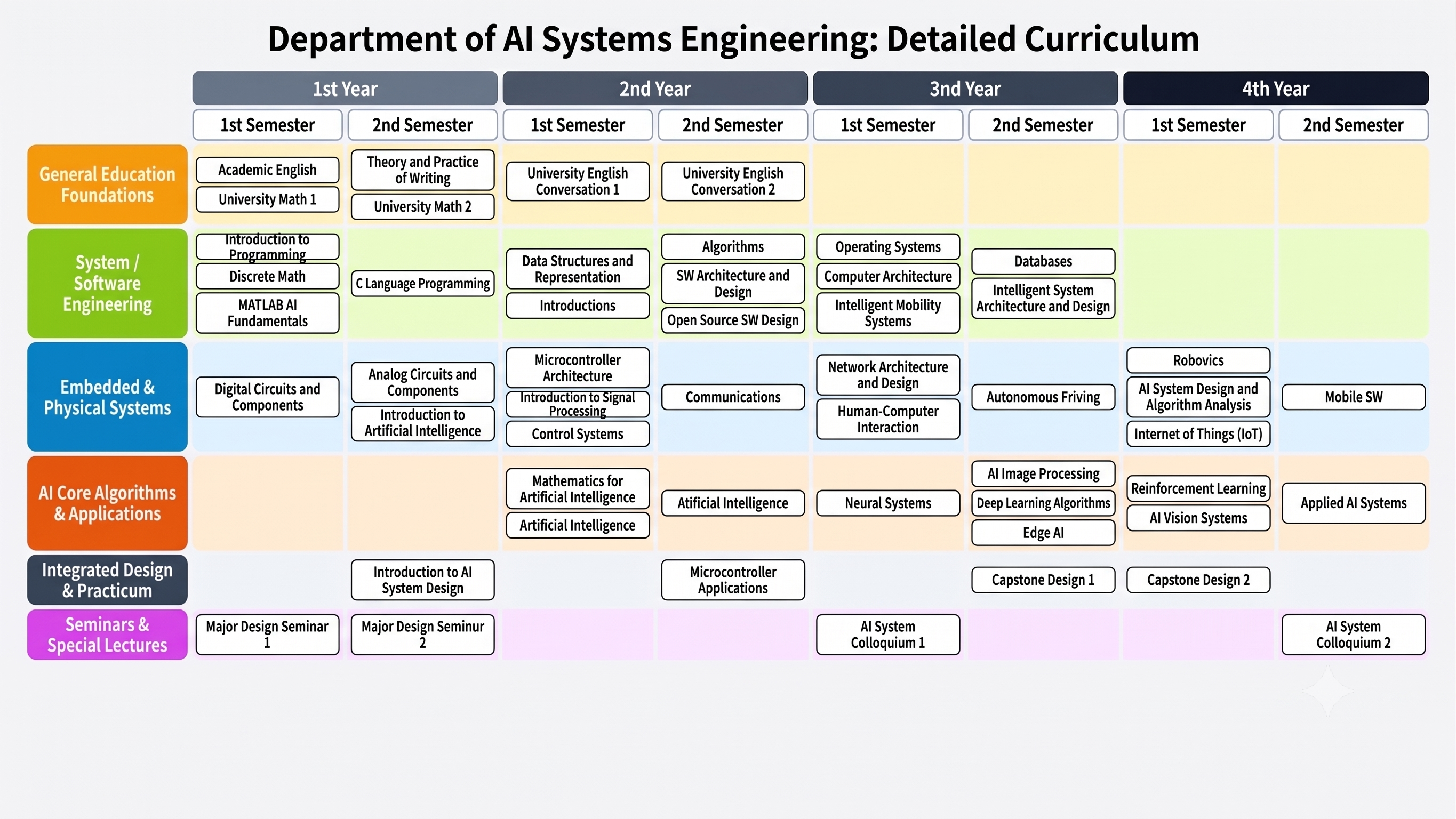
Calculus 1
Covers systems of linear equations, linear transformations, vector spaces, and eigenvalue problems based on the operations and properties of vectors and matrices. Students acquire the fundamental mathematical tools required to systematically approach engineering and IT problems and prepare for advanced major coursework.
Calculus 2
Continues the study of core linear algebra concepts, including systems of linear equations, linear transformations, vector spaces, and eigenvalue problems. Equips students with the analytical skills needed to solve complex physical and engineering problems and understand advanced computer science theories.
Introduction to Programming
Cultivates computational thinking and introduces AI development environments. Through hands-on practice with syntax and logical structures, students learn core programming components and the fundamentals of object-oriented and modular programming.
Discrete Mathematics
Introduces discrete structures essential for AI and computing systems, fostering mathematical reasoning for algorithm design and analysis. Covers propositional and predicate logic, set theory, relations, functions, and graph theory, establishing the theoretical foundations for AI model structures and data representation.
AI Computing with MATLAB
Builds data processing and visualization algorithm implementation skills using MATLAB to strengthen AI utilization capabilities. Through hands-on practice with real-world data in machine learning, image processing, and sensor data analysis, students experience core AI system principles and develop multidisciplinary problem-solving skills.
Digital Circuits and Devices
Explores hardware fundamentals and digital representation systems, spanning combinational and sequential circuits, finite state machines (FSM), datapaths, and register-transfer level (RTL) design methodologies. Integrates circuit simulation and hardware labs to provide hands-on experience with the baseline hardware abstraction layer where Physical AI systems operate.
C Language Programming
Focuses on memory-centric programming concepts, including variables, structures, arrays, pointers, and functions. Students gain an understanding of low-level programming and memory operations in embedded systems to build robust application software.
Analog Circuits and Devices
Covers analog electronic circuit principles essential for AI hardware platforms. Encompasses active and passive components, power supplies, amplifiers, filters, and ADC/DAC conversion circuits. Through circuit simulation and labs, students study the conversion and processing of continuous physical signals into digital domains.
Introduction to Artificial Intelligence
An introductory course examining foundational AI concepts, core technologies, and real-world industrial and societal applications. Students survey the definition of AI, problem-solving paradigms, and the operational mechanisms behind machine learning, deep learning, and generative AI.
Introduction to AI Systems Design
Explores foundational AI-driven system design using Arduino, digital fabrication tools (3D printing, laser cutting), and interactive programming. Students design and implement functional problem-solving prototypes integrating sensors, hardware, interfaces, and AI APIs, fostering creative engineering competencies in AI systems.
Data Structures and Representation
Examines classical linear and non-linear data structures—such as stacks, queues, trees, and graphs—alongside their complexity analysis, while investigating how these structures extend to embedding vectors and tensors in modern AI. Develops structural design capabilities to map unstructured data into numerical vector spaces for AI training.
Basic Communication
Introduces information communication and networking concepts, layered network architectures, and communication protocols. Covers wired/wireless communications, data transmission, and mobile communication systems, exploring next-generation communication applications integrated with Edge AI and Physical AI.
Microcontroller Architecture
Analyzes modern MCU internal architectures, CPU operation principles, memory organizations, buses, and interrupt systems. Provides a register-level understanding of core hardware peripherals, including GPIO, timers, ADCs, and serial communication interfaces (UART, I2C, SPI).
Introduction to Signal Processing
Introduces continuous and discrete-time signals and linear time-invariant (LTI) systems. Covers convolution, Fourier series and transforms (CTFT, DTFT), sampling theory, Z-transforms, frequency response, and the foundations of digital filters (FIR, IIR).
Control Systems
Introduces classical and modern control theories applied to physical systems such as autonomous vehicles, robotics, and drones. Topics include closed-loop control, PID controllers, mathematical modeling of dynamic systems, transient and steady-state response analysis, stability criteria, and frequency response methods.
Introduction to Data Science
Introduces Python and foundational data science libraries, including NumPy, Pandas, and Matplotlib. Students learn data manipulation, tensor operations, data visualization, and basic machine learning model implementation to resolve data-driven problems.
Artificial Intelligence
Focuses on machine learning principles and their practical implementation. Covers search strategies, optimization, knowledge representation, logical inference, intelligent agents, information theory, regression, neural network basics, and NLP embedding techniques through integrated theory and coding.
Algorithm
Covers fundamental computer science algorithms along with time and space complexity analysis. Focuses on C-based implementations of graph traversal, minimum spanning trees, shortest path algorithms, backtracking, and Huffman coding, targeting engineering challenges in mobility and autonomous systems.
Software Architecture and Design
Approaches software as a system of interacting components operating across interfaces and data streams. Covers requirements engineering, modular decomposition, interface design, concurrency control, memory hierarchy management, and end-to-end AI system integration.
Open Source Software Design
Covers open-source software development methodologies through theoretical and practical study. Encompasses Linux environments, Bash scripting, C/C++ compilation, Make utilities, Linux system calls (files, processes, signals, threads), and Git/GitHub collaboration workflows.
Communication Engineering
Establishes theoretical foundations for analog and digital signaling, spectrum analysis, and modulation techniques. Explores amplitude and digital modulation schemes, channel coding, multiplexing, multiple-access protocols, and communication system design tailored for next-generation mobility services.
Mathematics for Artificial Intelligence
Explores the core mathematical methods driving artificial intelligence models. Topics include eigendecomposition, principal component analysis (PCA), Bayesian probability, second-order Taylor approximations, optimization theory, linear programming, Lagrange multipliers, and Wiener filtering.
Microcontroller Applications
Provides hands-on experience in sensor and actuator interfacing using MCUs to implement embedded control systems. Students design and deploy real-world applications using digital I/O, PWM, ADC sensor data acquisition, communication protocols, and multi-sensor fusion.
Operating System
Examines the design principles and structural architecture of modern operating systems. In-depth topics include process and thread management, CPU scheduling, system calls, synchronization, deadlock mitigation, memory allocation, virtual memory, and file systems.
Computer Architecture
Analyzes the organizational structure and functional properties of CPUs, memory hierarchies, buses, and I/O subsystems. Investigates instruction set architectures (ISA), microarchitecture execution logic, modern computing paradigms, and distributed system architectures.
Intelligent Mobility Systems
Focuses on designing intelligent mobility platforms using Raspberry Pi, Pixhawk flight controllers, open-source autopilot stacks (PX4), and ROS integration. Integrates onboard sensors, autonomous flight algorithms, computer vision pipelines, and cloud AI connectivity to construct practical drone control architectures.
Network Architecture and Design
Adopts a top-down approach to computer networking architectures and internet protocol suites. Explores application-layer protocols (HTTP, DNS), transport-layer flow and congestion control (TCP/UDP), routing algorithms, link-layer mechanisms, and network security foundations.
Human-Computer Interaction
Examines interface design principles that facilitate interaction between Physical AI systems, human users, and their environments. Topics include user-centered design (UCD), cognitive modeling, physiological signal interfaces (EEG, EMG, PPG), brain-computer interfaces (BCI), VR/AR 3D spatial interactions, and human-robot interaction (HRI) ethics.
Neural Networks
Provides an extensive exploration of neural network architectures and learning dynamics. Traces the progression from backpropagation fundamentals to sequence and transformer models, including RNNs, LSTMs, Transformers, BERT, and large language model (LLM) architectures through theoretical study and implementation.
Database
Investigates relational database management systems (RDBMS) for scalable data storage, querying, and extraction. Covers entity-relationship (ER) modeling, relational algebra, advanced SQL queries, transaction management, concurrency control, and open-data integration projects.
Intelligent Systems Architecture and Design
Addresses systems engineering methodologies and structural design principles for deploying AI models into physical computing environments. Explores hardware-constrained trade-off analyses, bottleneck diagnostics using the Roofline model, specialized hardware accelerators, and HW-SW partitioning techniques.
Autonomous Driving
Covers core concepts and sensing technologies behind autonomous vehicles. Investigates displacement sensors, ultrasonic sensors, IMUs, LiDAR, and GPS, alongside state estimation, vehicle localization, lane detection algorithms, and longitudinal/lateral motion control mechanisms.
AI Image Processing
Examines deep learning-based computer vision and digital image processing algorithms. Covers image preprocessing, CNN-driven feature extraction, classification, object detection, semantic/instance segmentation, super-resolution, and action recognition from an implementation perspective.
Deep Learning Algorithms
Focuses on the structural foundations and training mechanics of deep neural networks. Covers multi-layer perceptron backpropagation, weight initialization strategies, regularization techniques, gradient descent optimization variants, hyperparameter tuning, and convolutional neural network (CNN) architectures.
Edge AI
Explores methods for deploying and optimizing deep learning models on resource-constrained embedded platforms like NVIDIA Jetson and Raspberry Pi. Topics include YOLO object detection, real-time streaming inference, model quantization, pruning, TensorRT and TFLite execution frameworks, and TinyML techniques.
Artificial Intelligence System Colloquium 1
Exposes students to cutting-edge technological advancements, market developments, and active research fronts across the AI systems domain through industry expert lectures, seminars, and academic discussions.
Robotics
Explores robotic modeling, dynamics, and feedback control methodologies tailored for Physical AI systems. Focuses on differential-equation-based time- and frequency-domain analysis, state-space representations, kinematic and dynamic modeling, Kalman filtering, and adaptive control applications.
AI Systems Design and Algorithm Analysis
Analyzes computational bottlenecks in modern AI through the lens of advanced algorithm design. Covers high-dimensional vector search, automatic differentiation, large-scale optimization (SGD, Adam), attention acceleration (FlashAttention), LLM inference serving optimizations (KV caching, PagedAttention), model compression, and distributed training algorithms.
Internet of Things
Examines modern networking protocols and scalable IoT architectures. Covers congestion control mechanisms, BGP routing, P2P networking, IoT security frameworks, sensor coverage algorithms, multicast protocols (DVMRP, MOSPF, PIM), smart mobility platforms, and wireless sensor network routing protocols (DSR, AODV).
Reinforcement Learning
Studies sequential decision-making frameworks centered on maximizing cumulative reward through environmental interaction. Covers Markov Decision Processes (MDP), dynamic programming, Monte Carlo methods, and temporal difference learning, progressing to deep reinforcement learning algorithms (DQN, Policy Gradient, Actor-Critic).
AI Vision System
Focuses on AI-driven image processing, video compression standards, and intelligent video analytics. Integrates video coding standards, deep learning object detection, video segmentation, multimodal vision models, and Edge AI deployment pipelines for industrial vision applications.
Mobile SW
Covers full-stack mobile web application development centered on Large Language Model (LLM) integration. Through project-based workflows, students implement Python SDK-based LLM pipelines, mobile database architectures, prompt engineering, text embeddings, vector databases, web user interfaces, and autonomous AI agent workflows.
Artificial Intelligence System Applications
Provides an in-depth investigation into key challenges, emerging trends, and deployment strategies across the AI systems industry, analyzing production case studies and future technology trajectories.
Artificial Intelligence System Colloquium 2
Broadens domain expertise and supports career alignment through industry guest lectures and technical seminars covering advanced research findings and breakthroughs in artificial intelligence systems engineering.