Incheon National University Professor Seo Myung-ji’s Research Team Achieves World-Class Production of 656.3 mg/L of 4,4′-Diaponeurosporene, a Rare Natural C30 Carotenoid Antioxidant, through Precision Microbial Design and Fermentation
- 글번호
- 426071
- 작성일
- 2026-06-23
- 수정일
- 2026-06-23
- 작성자
- 홍보과 (032-835-9490)
- 조회수
- 60

Professor Myung-ji Seo
Incheon National University (President: In-jae Lee) announced that a research team led by Professor Myung-ji Seo of the Division of Biotechnology has redesigned Corynebacterium glutamicum through precision metabolic engineering, enabling world-class production of 4,4′-diaponeurosporene (4,4′-DIA), a high-value C30 carotenoid material.
4,4′-Diaponeurosporene is a rare C30 carotenoid material known as a yellow natural pigment. It is particularly effective in removing reactive oxygen species, offering strong antioxidant effects that protect cells from oxidative stress. It also has functional properties such as anticancer and immune-enhancing effects, relief of inflammatory bowel disease, and enhancement of livestock immunity, drawing attention as a material for health functional foods, pharmaceuticals, cosmetics, and animal feed.
While widely known C40 carotenoid materials such as lycopene and beta-carotene have already been substantially commercialized, C30 carotenoids such as 4,4′-diaponeurosporene have not yet been commercialized because mass production has not been possible.
Professor Seo’s research team used synthetic biology, metabolic engineering, and combinatorial biosynthesis technologies to design a precision-engineered Corynebacterium glutamicum microbial system capable of efficiently producing 4,4′-diaponeurosporene. Through fed-batch fermentation, the team successfully produced 4,4′-diaponeurosporene at a level of 656.3 mg/L (21.9 mg/L/h). This represents a production level more than 160 times higher than that of existing recombinant Escherichia coli systems and more than 70 times higher than that of recombinant Bacillus subtilis, establishing a world-class precision microbial and fermentation system for 4,4′-diaponeurosporene production.
Professor Myung-ji Seo of the Division of Biotechnology at Incheon National University, who led the research, stated, “This study is highly meaningful in that we established a precision microbial system capable of producing 4,4′-diaponeurosporene at a world-class level.” She added, “Our goal is also to enable mass production and commercialization of other biomaterials currently being studied in our laboratory, particularly the C50 carotenoid bacterioruberin and 1-deoxynojirimycin, through precision microbial design and fermentation.” She further emphasized, “I believe the optimal production method for biomaterials we should pursue going forward is the sustainable mass production of expensive, high-value materials using safe and cost-effective microorganisms.”
The study was co-first-authored by Dr. Chi-young Hwang of the Department of Bioengineering and Nano-Bioengineering at Incheon National University, currently a postdoctoral researcher at the University of Minnesota, and Dr. Eui-sang Cho, a research fellow at the Honam National Institute of Biological Resources. Professor Sung-bo Kim of Yonsei University also participated as a co-author. The findings were published in the international journal Journal of Biological Engineering, which ranks in the top 5.8% of the 2024 JCR.
This research was supported by several projects funded by the Ministry of Science and ICT, including the 2022 Basic Research Program, “Development of a Production Process for Rare C30 Carotenoid Natural Pigments Based on Combinatorial Biosynthesis and an Optimized Corynebacterium glutamicum System” (RS-2022-NR072558); the 2025 Mid-Career Researcher Program, “Development of C50 Carotenoid Food and Pharmaceutical Materials for Alleviating Sarcopenia through Redesign of a Corynebacterium glutamicum System Based on Precision Fermentation” (RS-2025-00554776); and the 2025 Frontier Research Program, “Establishment of a Next-Generation Glucaric Acid-Producing Microbial Platform Based on Corynebacterium glutamicum for the Development of New Polyamide Bioplastic Materials” (RS-2025-16067759). It was also supported by the 2024 Academic Next Generation Support Program, funded by the Ministry of Education, for “Development of Corynebacterium glutamicum Strains for Mass Production of Water-Soluble C30 Carotenoids as Functional Food Materials” (RS-2024-00406342).
Paper information:https://doi.org/10.1186/s13036-026-00674-5
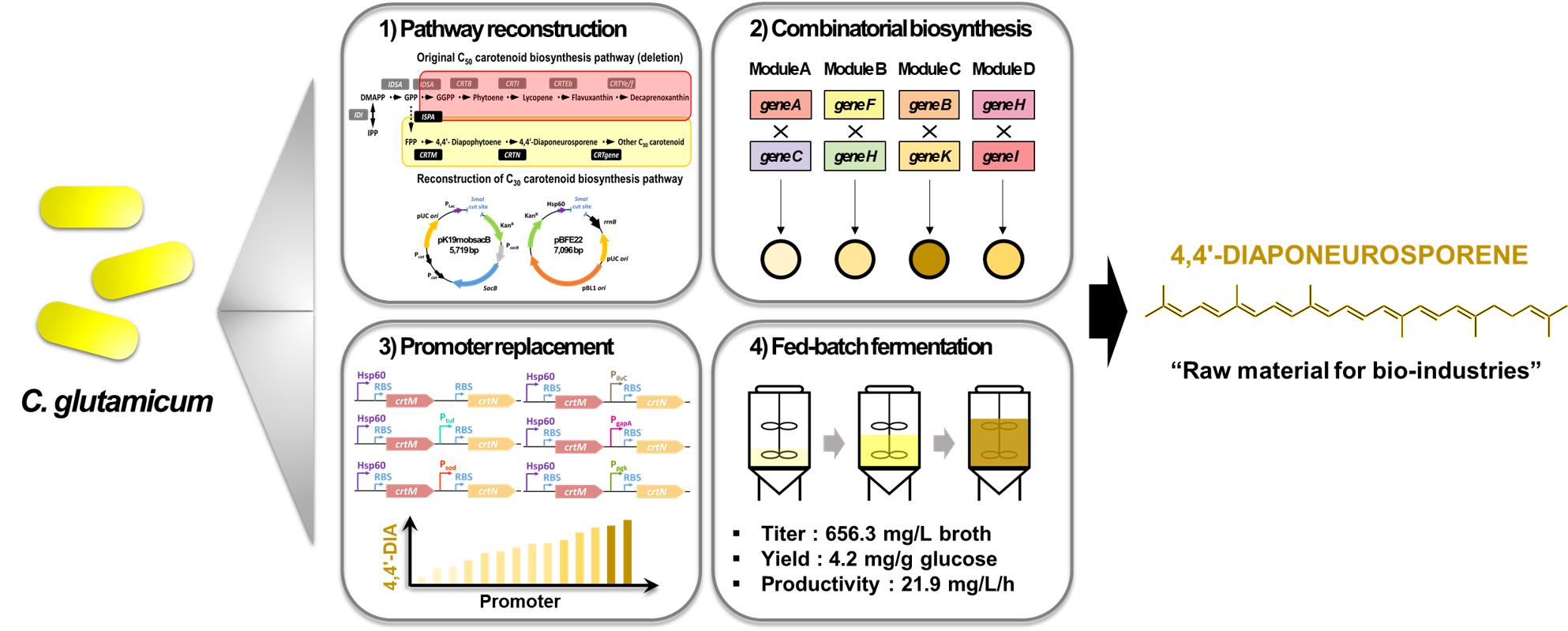
Schematic diagram of the production process of 4,4′-diaponeurosporene, a high-value antioxidant material, through precision microbial design and fermentation of Corynebacterium glutamicum