Incheon National University Innopolis Foundation and KCL Host Seminar on Domestic and Global Bioplastics Trends and Standardization
- 글번호
- 426063
- 작성일
- 2026-06-23
- 수정일
- 2026-06-23
- 작성자
- 홍보과 (032-835-9490)
- 조회수
- 1320
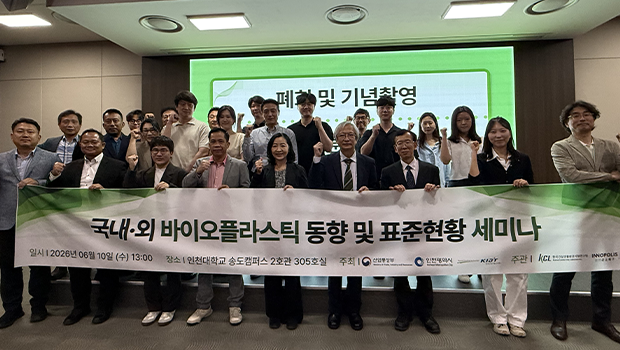
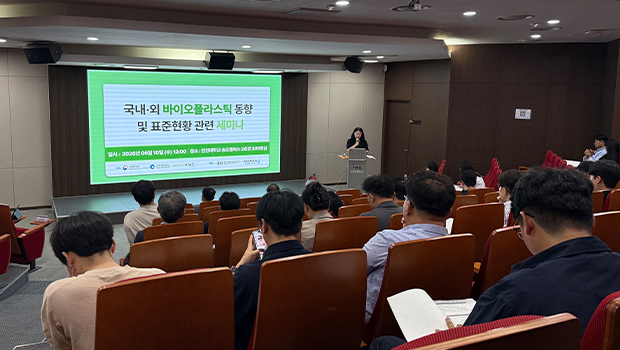
Incheon Innopolis and KCL Successfully Hold Seminar on Domestic and Global Bioplastics Trends and Standardization
● Sharing domestic and global bioplastics trends and the current status of international standards
● Strengthening foundations for technology commercialization, testing and certification, and global market entry for Innopolis companies
Incheon Innopolis (Director: Hee-kwan Lee, Professor of the Division of Urban and Environmental Engineering at Incheon National University) jointly held the “2026 Seminar on Domestic and Global Bioplastics Trends and Standardization” with the Korea Conformity Laboratories (KCL) on June 10 in Room 305 of Building 2 at Incheon National University’s Songdo Campus.
The seminar was organized to share domestic and global technology trends and international standardization developments in the bioplastics industry and to explore directions for technology commercialization linked to the specialized fields of Incheon Innopolis.
The event was hosted by the Ministry of Trade, Industry and Energy, Incheon Metropolitan City, and the Korea Institute for Advancement of Technology, and jointly organized by KCL and Incheon Innopolis. It brought together domestic and international experts in bioplastics, industry professionals, Innopolis company representatives, and graduate students to share insights on technology and standardization trends.
Bioplastics are gaining importance amid industrial shifts toward carbon neutrality, resource circulation, and ESG response. International standards, testing and certification, and demonstration-based validation are increasingly regarded as key factors for corporate competitiveness and overseas market entry.
The seminar consisted of three sessions. Major topics included the current status of the petrochemical industry and national policies, ISO-based global environmental standardization roadmaps, standardization trends based on Thailand’s BCG policy, marine biodegradation testing methods, international standardization trends for bioplastics based on mass balance, and the need for demonstration and standardization of marine biodegradable buoys.
The seminar also covered the need for demonstration projects and international standardization in Jeju, as well as the current status of white biotechnology support programs related to Incheon Innopolis. After the sessions, an expert discussion was held, during which participants exchanged views on domestic and global developments in bioplastics, key challenges, and future cooperation opportunities.
Speakers included domestic and international experts from the Korea Petrochemical Industry Association, Japan’s National Institute of Advanced Industrial Science and Technology (AIST), Thai Wah PCL, a Thailand-based agricultural food and starch-based materials company, Politeknik AUP, an Indonesian fisheries and marine vocational education institution, and the Korea Bio-Chemical Industry Association. They shared a wide range of insights on bioplastics industrial policies, international standards, marine biodegradation technologies, and demonstration cases.
Incheon Innopolis explained that the seminar served as an opportunity to enhance Innopolis companies’ understanding of bioplastics technologies and standards, while expanding their potential to utilize testing and certification, secure product reliability, and enter global markets.
Director Hee-kwan Lee of Incheon Innopolis said that bioplastics are an important field related to materials and technology. He added that the seminar provided an opportunity for participating companies to review technology trends and discuss related projects.
He continued, “As a regional innovation platform supporting the growth of companies based on environmental technologies, Incheon Innopolis will continue to actively support technology commercialization and global expansion for Innopolis companies through cooperation with related institutions.”
Incheon Innopolis website: www.iic.or.kr