Professor Han-boram Lee’s Research Team at Incheon National University Publishes Paper in JACS, One of the World’s Leading Chemistry Journals
- 글번호
- 426057
- 작성일
- 2026-06-23
- 수정일
- 2026-06-23
- 작성자
- 홍보과 (032-835-9490)
- 조회수
- 1145

From left: Professor Han-boram Lee and Kyung-min Min, Integrated Master’s and Ph.D. student
A research team led by Professor Han-boram Lee of the Department of Materials Science and Engineering at Incheon National University (President: In-jae Lee) has published its findings in the Journal of the American Chemical Society (JACS, Impact Factor: 15.7), one of the world’s most prestigious journals in chemistry. The study is drawing attention from both academia and industry by fundamentally addressing the long-standing limitation of interfacial oxide formation in the atomic layer deposition process of ruthenium, a promising wiring material for next-generation semiconductors.
As semiconductor processes continue to shrink to the nanometer scale, ruthenium has emerged as a strong candidate to replace conventional copper interconnects. However, existing ruthenium deposition processes have relied on strong oxidizing agents. This approach causes a critical side effect by simultaneously oxidizing the underlying substrate during the initial deposition stage, sharply increasing contact resistance. Alternative processes using hydrogen molecules or plasma have been proposed, but hydrogen molecules face excessively high chemical reaction barriers, making it difficult to deposit high-purity ruthenium. Plasma processes also have limitations in complex three-dimensional structures, as active species recombine before reaching the bottom of the substrate, preventing uniform thin-film growth.
To overcome these limitations, Professor Lee’s research team introduced an original approach using atomic hydrogen, produced by pre-dissociating molecular hydrogen, as a reactant. The team designed a process that stably supplies atomic hydrogen using a hot-wire system. This atomic hydrogen dramatically lowers the decomposition reaction barrier of the ruthenium precursor and effectively removes organic ligands from the precursor even at an extremely low deposition temperature of 100 °C. The team thoroughly identified this chemical mechanism through both theoretical and experimental analysis.
Furthermore, the research team also demonstrated the potential to expand this process to area-selective atomic layer deposition (ASD), a next-generation fine-patterning technology. This achievement strengthens the foundation for selectively depositing ruthenium thin films only on specific surfaces of semiconductor devices. The results showed that by reintroducing a surface-blocking layer, growth in undesired areas could be completely suppressed while ruthenium was precisely grown only in the target areas.
This achievement has significant academic value in that it provides chemical guidelines for uniformly depositing high-purity metal interconnects within complex nanoscale semiconductor architectures. From an industrial perspective, it is also expected to serve as a key result for securing competitive metal interconnect technology that can maximize the yield and electrical performance of next-generation semiconductor manufacturing processes.
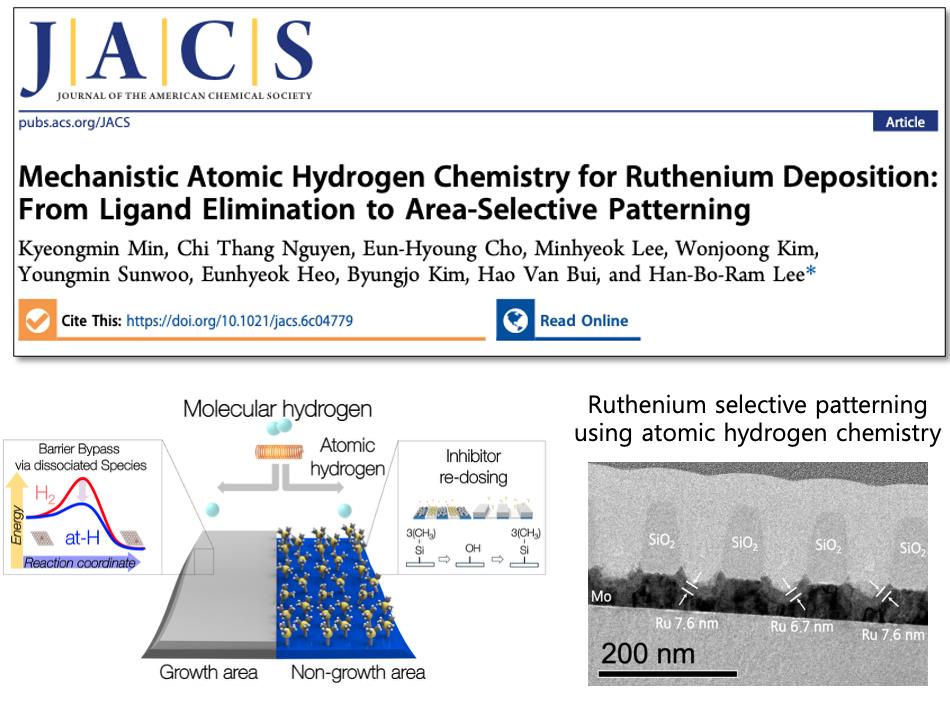
Implementation of area-selective atomic layer deposition of ruthenium using the chemical mechanism of atomic hydrogen